
Japanese Tattoos: Complete Style Guide
Summary
Here are the core things to understand about Japanese tattoo style:
- Japanese tattoo style: A large-scale tattoo system built around one main subject, strong body flow, and a structured background.
- Popular subjects: Koi, dragon, tiger, hannya, oni, phoenix, snake, peony, and chrysanthemum.
- Japanese tattoo backgrounds elements: waves, clouds, wind bars, rocks, smoke and fire.
- Key elements: Clear hierarchy, bold contrast, clean spacing, readable shapes, and background that connects the tattoo to the body.
- Best placements: Back, sleeve, chest, thigh, ribs, and other areas with enough space for movement.
Japanese tattoo style, often called Irezumi, is a large-scale tattoo system built around one main subject, strong body flow, and a structured background of waves, clouds, wind, rocks, or flames. It is not just about choosing a dragon, koi, tiger, or hannya mask. The strength of the style comes from how everything connects.
So no, this is not the right style for a tiny, over-detailed ankle stamp. Japanese tattooing is built to move with the body. It works best when the artist has enough space to create structure, rhythm, and flow—more like armour than a random collection of small symbols. That matters when choosing a Bali tattoo studio too, because the real question is not just who can tattoo the subject, but who can make the whole composition work on your body.
The wrong background can make a Japanese tattoo feel like separate stickers. Talk to our team about how you want the whole piece to come together.
What exactly is the Japanese tattoo style?

Japanese tattoo style is designed to be read as one connected composition across larger areas like sleeves, back pieces, chest panels, thighs, and full bodysuits.
Think of it this way: A dragon without a background is just a sticker on a fridge. A dragon with wind bars and waves is a mural.
The background is not decoration. It is the layout tool. It connects the main subject to your body’s anatomy so the tattoo flows instead of looking like separate patches of ink.
Strong Japanese tattooing usually works in three layers:
- Foreground: The main subject, such as a dragon, koi, tiger, snake, phoenix, hannya, or oni.
- Mid-ground: Supporting elements, such as peonies, chrysanthemums, cherry blossoms, rocks, flames, or leaves.
- Background: The environment, such as waves, wind bars, clouds, smoke, or water.
This hierarchy is why strong Japanese work still looks clean when it is healed. It relies on big shapes and flow, not just tiny details.
Irezumi, Horimono, Wabori, and Tebori: what do these words mean?
Japanese tattoo terminology can be confusing because different artists use these words in slightly different ways.
- Irezumi usually refers to Japanese-style tattooing in general.
- Horimono means "carved thing" and is often used by traditional Japanese tattooers to describe large-scale decorative tattoo work.
- Wabori refers to Japanese-style tattooing, especially work that follows traditional Japanese visual language, motifs, and composition.
- Tebori refers specifically to the traditional hand-poked tattooing method. It is a technique, not a separate design style.
- Gakubori is the background itself. The word means framed carving, and the job is to frame the main subject the way a border frames a painting.
- Mikiri is the border where the tattooed background stops and bare skin starts. A clean mikiri makes a sleeve look finished. A sloppy one makes the whole piece look unfinished even when the subject is perfect, which is one reason it pays to work with an artist who can explain background structure before drawing.
- Bokashi is the graded shading that fades black into open skin. It is what stops a flat background from looking like a solid patch.
You do not need to use every term perfectly. The important part is understanding the difference between the style, the layout, and the technique.
What defines a Japanese tattoo?
A strong Japanese tattoo should look planned from the beginning. The background, supporting elements, and main subject should work together as one system instead of looking like separate symbols placed next to each other.
You can usually recognise strong Japanese tattooing through details like these.
1. Connected background
Waves, wind bars, clouds, smoke, or water should control the rhythm of the tattoo. The background is what connects the main subject to the body and keeps the whole piece from looking like separate patches of ink.
2. Anatomical flow
The design should wrap naturally around shoulders, elbows, ribs, hips, knees, or the back. Japanese tattooing works best when the composition moves with the body instead of fighting against it.
3. Clear hierarchy
You should be able to identify the main subject quickly, even from a distance. The dragon, koi, tiger, hannya, or other main image should lead the design, while the background and supporting elements frame it.
4. Breathing room
Negative space keeps the tattoo from turning into one dark patch as it ages. Strong Japanese tattooing does not rely on cramming every inch with detail. It needs open space, contrast, and clean separation.
5. Consistent visual language
The line weight, shading, background, and supporting elements should feel like they belong in the same world. A Japanese tattoo starts to look messy when every part feels like it came from a different design.
6. Wind bars
Wind bars are the bold, curved background shapes often used in Japanese tattooing to create movement and separate the main subject from the skin. They are one reason Japanese sleeves and backpieces can look so powerful from far away.
Where did Japanese tattooing come from?
Japanese tattooing has deep cultural roots and a history that is often tied to outlaws and the fringes of society. At different points, tattoos were both celebrated as high art and used as a form of punishment.
You do not need to memorize dates to appreciate the style. You just need to understand that this art is globally respected but still has a complicated reputation in Japan.
If you travel in Japan with visible tattoos, check the rules before entering onsen, gyms, pools, and some public bathing facilities. Many places are more flexible now, but restrictions still exist.
Tebori vs. machine: what is the real difference?
Tebori is the traditional hand-poking method, while the machine is the modern electric standard. Neither is better, but they produce distinct results that age differently.
- Tebori (Hand-Carved): The artist uses a tool to rhythmically push ink into the skin. It creates a unique, slightly grainy texture (often called "wabi-sabi") and causes less trauma, meaning a faster heal. The sensation is often described as a dull thud rather than a scratch.
- Machine (Electric): The artist uses a standard tattoo gun. It creates solid, saturated blocks of color and sharp, consistent lines much faster than a human hand can. It is efficient, but the sensation is a sharper, constant scratching.
If you want the traditional texture and ritual, choose Tebori. If you want bold saturation and speed, choose the machine.
How well do Japanese tattoos age over time?
Japanese tattoos can age extremely well because the style naturally supports longevity. Big shapes, strong contrast, clear outlines, and readable backgrounds all help the tattoo stay clean over time.
But clients often sabotage the style by asking for too much in too little space.
Too much detail, too many elements, and not enough background can make the tattoo look impressive on day one but messy after healing and aging. Japanese tattooing works best when the artist controls the composition instead of cramming every possible symbol into the design.
Japanese vs American Traditional: which one should you get?
Japanese and American Traditional tattoos can both be bold, readable, and built to last. The difference is composition.
Japanese tattooing usually works as one connected scene. American Traditional usually works as standalone icons.
Japanese vs American Traditional
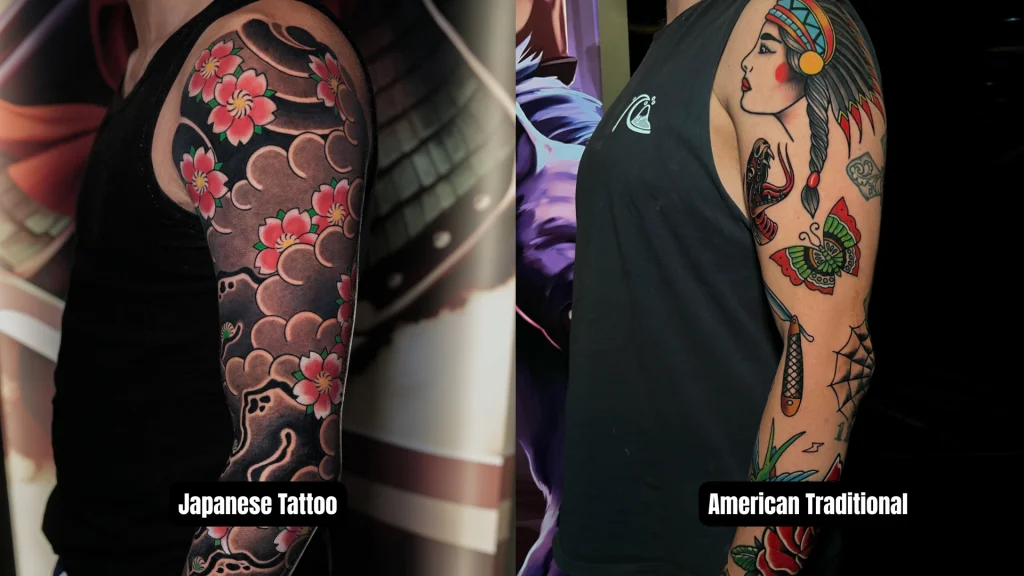
Use this quick table to see the differences at a glance.
Key difference | Japanese Traditional | American Traditional |
Structure | One unified scene with subject and background | Standalone icons |
Flow | Designed around body anatomy | Designed like stickers |
Best scale | Medium to huge | Small to large |
Readability | Cinematic and layered | Instant, punchy |
Vibe | Mythic, protective, narrative | Classic, blunt, iconic |
If you want a tattoo that looks like it belongs on your body and can grow into a bigger project later, Japanese is the move. If you want something iconic, simple, and instantly readable, American Traditional is easier.
What do common Japanese tattoo symbols mean?
Common Japanese tattoo symbols usually represent ideas like strength, protection, endurance, transformation, beauty, and resilience.
Popular Japanese tattoo motifs include:
- Koi: Perseverance, transformation, and endurance.
- Dragon / Ryu: Power, wisdom, protection, and elemental force.
- Tiger / Tora: Strength, courage, and protection.
- Hannya mask: Jealousy, rage, sorrow, and emotional transformation.
- Oni: Danger, punishment, protection, or controlled chaos, depending on the design.
- Phoenix / Hou-ou: Rebirth, renewal, and rising from destruction.
- Snake / Hebi: Protection, transformation, rebirth, and sometimes danger.
- Peony / Botan: Beauty, strength, and confidence.
- Chrysanthemum / Kiku: Longevity, resilience, renewal, and nobility.
- Cherry blossom / Sakura: Beauty, impermanence, and the short nature of life.
Do not build your tattoo like a buffet plate. Pick one main subject and let the artist build the world around it.
What do Japanese tattoo background elements mean?
Japanese tattoo backgrounds carry fixed meanings the same way the main subject does. The waves are not there to fill the gap around the koi. They are the koi's struggle.
- Waves (nami): Life's force, struggle, and resilience. Rough cresting water raises the drama, flatter water lowers it.
- Wind bars (kaze): Movement, air, and unseen force. The bold curved bars that carry the eye through the piece.
- Clouds (kumo): The celestial realm, height, and transition. Standard company for dragons and phoenixes.
- Rocks (iwa): Permanence, endurance, and solid ground. They anchor a composition that would otherwise float.
- Flames (honoo): Destruction, purification, and rebirth. Common under a phoenix or behind a hannya mask.
- Maple leaves (momiji): Impermanence, the passage of time, and beauty in change. Autumn.
Japanese tattoo background patterns come from a fixed set rather than an artist's invention, but the naming varies by lineage. Wind bars turn up as kaze, kazekiri, and kaze-sen depending on who trained your tattooer. Nobody will correct you at the consultation.
What Japanese tattoo ideas work best?


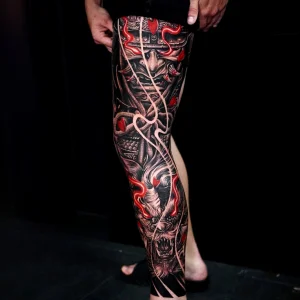
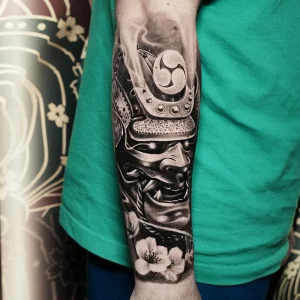


The strongest Japanese tattoo ideas are complete compositions, not just individual subjects. The subject, background, and placement should work together, because changing one can change the whole balance.
- Koi ascending through wind bars, wrist to shoulder. Water sits lower on the arm while the wind bars carry the composition upward, giving the koi a clear sense of movement.
- Dragon head at the shoulder, clouds through the bicep. The head gets the space it needs while the clouds help connect the larger composition around the arm.
- Tiger in bamboo, outer thigh. The wider surface gives the tiger room to read clearly, while the bamboo adds vertical movement around it.
- Hannya with falling petals, rib to hip. The vertical placement suits the mask, while the petals help soften the transition into the surrounding space.
- Phoenix through flames, upper back. The back gives the phoenix enough room for its shape and tail to spread without crowding the composition.
- Snake and peonies, half sleeve. The snake can follow the shape of the arm, while the peonies give the composition enough weight to feel complete.
The scale is part of the design. Shrinking a Japanese composition too far can remove the space it needs to read properly.
The Japanese work in our gallery shows how waves, wind bars, and clouds sit against different subjects across sleeves, thighs, and back pieces. See Japanese Work.
Does getting a Japanese tattoo hurt more than other styles?

Japanese tattoo pain is usually not difficult because of one sudden shock. It becomes difficult because large-scale pieces take time.
A full sleeve, chest panel, thigh piece, or back piece is an endurance project across multiple sessions. The pain depends on placement, session length, shading density, your skin, your sleep, and how well you prepare.
Tebori and machine tattooing also feel different. Tebori is often described as slower, heavier, and more rhythmic. Machine tattooing usually feels sharper and more constant.
Most people can handle large Japanese work with proper pacing, food, rest, and realistic expectations.

Where is the best placement for Japanese tattoos?
Japanese tattoos need space and flow. The best placements are back, sleeves, chest, thighs, ribs, and other areas that allow the composition to breathe and move.
Body part | Pain level | Best designs |
High | Dragons, deities, full scenes, bodysuits | |
Moderate | Koi and waves, snakes, florals, dragons | |
Chest | High | Tigers, masks, phoenix, paired compositions |
Thigh | Moderate | Koi, peonies, snakes, background-heavy work |
Very high | Wind, waves, snakes, vertical compositions |
Japanese tattoos need space. A full dragon does not want to live in a parking spot.
Are Japanese tattoos good for cover-ups?
Japanese tattoos can work well for cover-ups because the style uses strong outlines, dark backgrounds, waves, clouds, wind bars, and bold contrast. These elements give the artist more room to hide old ink and redirect the eye.
But not every old tattoo can be covered cleanly with Japanese work. The result depends on the size, darkness, placement, scarring, and shape of the existing tattoo. Sometimes the smarter move is laser fading first, then building the new Japanese piece properly.
Is a Japanese tattoo a good first tattoo?
A Japanese tattoo can be a good first tattoo if you are ready for scale, planning, and multiple sessions. The style ages well when it has enough space, clear structure, and a strong main subject.
It is not the best first tattoo if you want something tiny, quick, and packed with detail. Japanese tattooing works better as a planned composition than a small impulse piece.
How do you plan for a Japanese tattoo in Bali?
Large Japanese tattoos need more planning because session length, placement, and early healing all affect the final result.
Before booking, talk to the tattoo studio about your idea and travel schedule. A good studio can help estimate timing, session count, and whether the plan makes sense for your trip.
Before your appointment:
- Finish surfing, swimming, gym, and heavy sun exposure.
- Decide the size and placement early.
- Wear loose clothing.
- Avoid long scooter rides after big rib, thigh, chest, or back sessions.
The goal is simple: enjoy Bali first, get tattooed near the end, and give the tattoo clean conditions to heal.
Planning a Japanese Tattoo in Bali?
Japanese tattoos need space, flow, and smart timing. Share your idea with Canggu Ink Club and we will help you figure out what works for your body and Bali schedule.
Conclusion
Japanese tattooing is not just about the main subject. It is about structure, flow, contrast, spacing, and how the entire piece works together on the body. A strong Japanese tattoo should still read clearly years later, not just look impressive on day one. Do not chase more detail. Chase better composition. That is what ages well.
FAQ
Common questions about Japanese-style tattoos.
Not automatically. Disrespect usually comes from treating the style like a costume: random symbols, sloppy mixing, zero curiosity, or copying someone else’s exact tattoo. Learn the basics, choose thoughtfully, and work with an artist who understands Japanese composition.
Yes, but small scale often loses what makes Japanese tattooing special. The style works best with background, movement, and enough space for the subject to breathe. For a small Japanese tattoo, keep the design simple. Do not try to squeeze a full dragon, waves, flowers, clouds, and a mask into a palm-sized patch.
No. Japanese tattoos can work in full color, black and grey, or mostly black with selective color. The important part is not the color palette. It is the structure, contrast, and readability.
Usually yes. Background is normally the last stage of the work, so an existing subject can often be extended into waves, clouds, or wind bars later. The catch is the mikiri, since the border has to be planned around what is already on the skin rather than drawn freely.
It depends on the size, detail, artist speed, technique, and whether the tattoo is black and grey or full color. A serious Japanese sleeve usually takes multiple sessions, not one quick appointment. Plan for the project, not just the first session. A better tattoo is worth the extra time.
