
Full Body Tattoo in Bali: Time, Cost and Planning
Quick Summary
Before starting, know what a full body tattoo realistically involves:
- Definition: A full body tattoo, or bodysuit, is a connected composition covering most of the body rather than separate tattoos collected over time.
- Total hours: Expect at least 150 hours, with dense work and solid backgrounds potentially exceeding 300.
- Session limits: Most sessions run six to nine hours, followed by a two-to-four-week break before working the same area again.
- Bali constraint: A standard 30-day Visa on Arrival can be extended once to 60 days, limiting how much tattooing you can realistically fit into one trip.
- Realistic timeline: Completing a full bodysuit typically takes at least four to eight trips, often spread across several years.
A full body tattoo is one connected composition covering most of the body, usually the back, chest, stomach, arms and legs. It is achievable at a Bali tattoo studio, and the cost can be lower than in Sydney, London or Los Angeles. But the real limits are time and healing: a bodysuit takes multiple sessions, not a single holiday.
That is the part almost every page on this topic skips. Search "full body tattoo" and you get hour counts and price ranges pulled out of the air, with nothing about the actual ceiling on how much skin can be worked and healed in a given window. In Bali that ceiling matters more than the price, because the thing you are short of is not money. It is trips.
Want to know how long your full body tattoo could take, what it might cost, or how to plan the sessions? Talk to our team for a personalised quote and consultation.
What counts as a full body tattoo?
A full body tattoo covers the torso and limbs as one design, with a deliberate plan for how each section connects to the next. Coverage alone does not make it one.
When people say “full body tattoo”, they can mean several different things:
- Bodysuit: A planned composition across the back, chest, stomach, arms and legs. Traditional Japanese bodysuits can use a split-chest layout known as munewari, which leaves a strip of skin through the centre of the chest.
- Full coverage: Nearly all available skin is tattooed, potentially including areas such as the hands, neck and feet.
- Blackout: Large areas are filled solid rather than built around individual subjects. This is a different approach from a traditional bodysuit.
- A collection: Multiple tattoos covering much of the body but without a shared composition or connecting background.
The difference matters because a bodysuit has to be planned as one piece. Background, spacing and transitions determine how the sections connect, so the order you build them can affect the finished result.

How many hours is a full body tattoo?
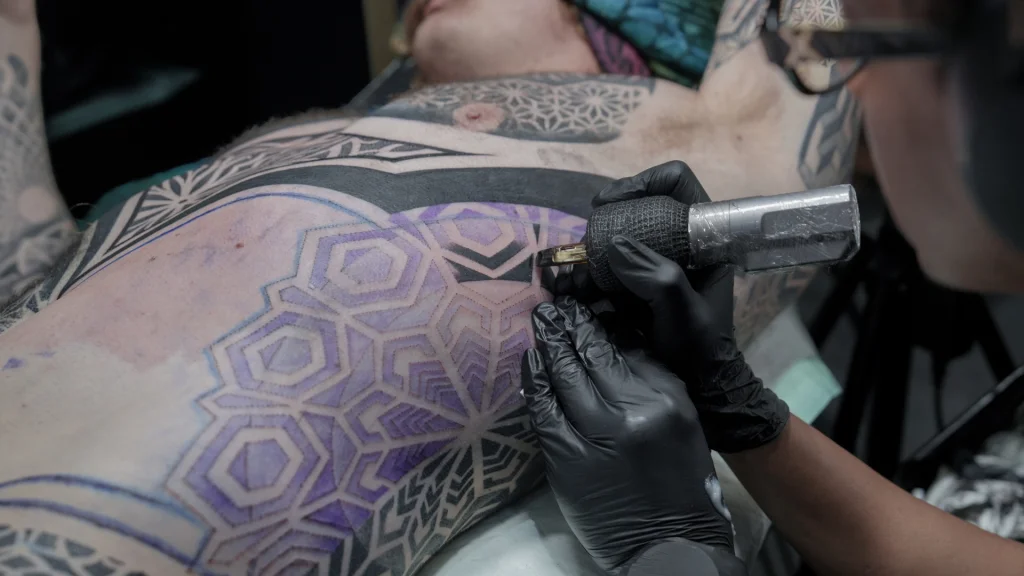
At Canggu Ink Club, a full body tattoo can take around 90–140+ hours of actual tattooing, based on the typical time needed for each major body section. The final total varies with the design, density and shading.
Area | Typical tattooing time |
2–3 days, around 8 hours per day | |
2–3 days, around 8 hours per day | |
2–3 days, around 8 hours per day | |
Chest and stomach | 1–2 days, around 8 hours per day |
Hands, neck, feet | 2–4 hours each |
These are working estimates rather than fixed durations. Open designs can move faster, while dense blackwork, heavy shading and detailed backgrounds can add significantly more time.
The key point is that a full body tattoo is a long-term project, not a single holiday tattoo. Your skin needs time to heal between sessions, even when you can handle long days in the chair.
How many tattoo sessions can you fit into one Bali trip?
A full body tattoo cannot simply be scheduled as one continuous block, even if you are willing to spend all day in the chair. The limiting factor is how much skin your body can reasonably recover from between sessions.
That does not mean you have to wait for one section to be completely healed before tattooing anywhere else. Different areas can sometimes be worked on during the same trip, depending on the size of the sessions, how your skin is responding and which areas are being tattooed. Your artist can decide how closely the sessions should be spaced.
So instead of booking every available day, plan the trip around tattooing time + recovery time.
Time in Bali | Practical approach |
2–3 days | One substantial session or a smaller connected section |
4–7 days | Multiple sessions may be possible, depending on the areas and skin response |
1–2 weeks | More substantial progress, with recovery time built into the schedule |
For a bodysuit, this is why multiple Bali trips can make more sense than trying to tattoo everything at once. The design can continue from one trip to the next without forcing every section into the same healing window.
How long does a full body tattoo take to heal?
Most tattooed skin takes a few weeks to settle on the surface, while deeper healing can continue for several months. Larger and denser areas may take longer to fully recover.
For a bodysuit, you do not necessarily have to wait for one section to completely heal before tattooing another. Your artist can space sessions based on the size, location and condition of each area.
How do you plan a bodysuit across multiple Bali trips?

Plan the overall design before your first session, then break it into sections that can be completed across multiple trips.
- Map the design first. Decide where each main subject goes, how the sections connect, and how the design flows across the body.
- Stick with the same artist. A bodysuit can take years to complete, so keeping the same artist helps maintain consistent linework, shading and background elements.
- Plan around healing. Start with larger, easier-to-heal areas and leave sensitive placements such as the ribs, sternum, hands and neck for later. Your artist can help plan each trip around healing time and the next section.
- Plan your next session before leaving. If you only visit Bali once a year, book the next stage early so your project does not lose momentum.
If you are still deciding between a connected bodysuit and separate pieces, see our patchwork versus sleeve comparison.
How much does a full body tattoo cost in Bali?
A full sleeve in Bali can cost around IDR 20–25 million (US$1,100–1,400) for a custom project. Scale that across both arms, both legs, the back, chest and stomach, and a full bodysuit can easily pass IDR 100 million (US$6,000+).
That is a rough project-level estimate, as the final cost depends on the size, detail, shading, colour and coverage of each design.
At Canggu Ink Club, tattoos are priced per design, not by the hour. A design that takes longer to tattoo does not automatically cost more, because the quote is based on the artwork rather than the clock. For a large project, each section can be quoted separately, giving you a clearer budget as the bodysuit takes shape.
If you are travelling to Bali for the work, factor in flights, accommodation and the time between sessions as well. The tattoo itself can run into five figures in USD, and completing a bodysuit is also a travel commitment.

What full body tattoo ideas work best for men and women?
The best full body tattoos are built as a visual system, not a collection of individual pictures. At this scale, the design has to move across shoulders, hips and knees while still reading as one composition.
That is why styles with built-in background and connecting elements, such as waves, wind bars, clouds, smoke, foliage or geometry, tend to work particularly well.
Style | Why it works at full body scale | The trade-off |
Japanese, irezumi | Designed around foreground subjects, backgrounds and anatomy | Strong stylistic rules |
Ornamental, mandala, geometric | Modular, repeatable and naturally suited to symmetry | Alignment needs to be precise |
Blackwork and negative space | Uses skin breaks as part of the composition | Requires careful planning of coverage |
Works well for large focal subjects | Needs enough space and contrast | |
Botanical and landscape | Flexible and easy to connect across body sections | Can become visually busy without a clear focal point |
Fine line can work, but it needs more planning at full-body scale. Thin details can soften over time, so spacing, scale and placement matter more when the same approach is repeated across multiple sections.
The bigger decision is whether you want one visual language or several styles. A Barong back, Japanese dragon sleeve and realism thigh can work together, but they need some connecting element if you want them to read as one bodysuit rather than separate tattoos.

Which parts of a full body tattoo hurt the most?
Pain varies from person to person, but some areas are generally more challenging than others. Ribs, sternum, stomach, inner arms, hands, feet and neck tend to be more sensitive, while areas such as the outer arm, thigh and upper back are often easier to sit through.
This is another reason to plan a bodysuit around more than just the fastest possible schedule. Long sessions on sensitive areas can affect how comfortably you can continue the project.
Planning a full body tattoo in Bali?
Not sure where to start or how many sections you can fit into one trip? Share your design idea and travel dates, and we will help map out a realistic plan.
Conclusion
Bali is a good place to build a full body tattoo and a bad place to try to rush one. The artists, the pricing and the trip structure all work in your favour if you treat the project as something built across years and plan the composition accordingly. What will not bend for you is the hours the design needs and the amount of skin you can heal at a time, and those two limits are what turn ambitious trip plans into patchy healing and disconnected panels.
FAQ
Here are the answers to the most common questions about full body tattoo.
Yes. Different styles can work together when they share connecting elements such as backgrounds, spacing, colour, or recurring motifs. Plan these connections early so the finished bodysuit feels cohesive.
Sometimes. Existing tattoos can be worked into the larger composition with new tattoos, backgrounds, or connecting elements. It depends on their style, size, placement, and the surrounding skin.
Sometimes. You do not necessarily need to wait for the entire bodysuit to heal before continuing elsewhere, but the artist should assess the skin and decide how closely the sessions can be scheduled.
A full body tattoo is often called a bodysuit or full body suit, particularly when the tattoos are planned as one connected composition.

